
For many Orange County veterans with a 100% service-connected disability rating, the house is the one thing they managed to hold onto. It is where the grab bars went in, where the ramp was built, and where a spouse or adult child now helps with the day-to-day. It is also where a property tax bill arrives every fall. On September 28, 2026, Governor Newsom signed Senate Bill 296 (Chapter 727, Statutes of 2026). Starting with the January 1, 2027 lien date, it replaces California’s long-standing flat-dollar exemption for these veterans with a much larger one: half of the home’s assessed value, up to $1,000,000, comes off the tax roll, and lower-income veterans and surviving spouses can exempt all of it. Here is what the law says, who qualifies, and what OC families should do before the next filing season.

SB 296 applies to the principal residence of veterans rated 100% disabled from a service-connected injury or illness, and to certain unmarried surviving spouses.
What SB 296 Actually Does
SB 296, authored by Senator Archuleta, adds a new section, 205.5.1, to California’s Revenue and Taxation Code. For five years it operates in place of the existing disabled veterans’ exemption in Section 205.5, which most eligible homeowners in Orange County know as the basic and low-income Disabled Veterans’ Exemption.
The difference is in how the break is measured. The current exemption removes a fixed dollar amount from a home’s assessed value, adjusted each year for inflation. SB 296 removes a percentage of the value instead:
1. The standard benefit: 50% of value, up to $1,000,000
If the home is owned by and is the principal residence of an eligible veteran, the veteran’s spouse, or both jointly, 50% of the part of its full value that does not exceed $1,000,000 is exempt. There is no income test for this tier.
2. The lower-income benefit: 100% of value, up to $1,000,000
If the veteran’s household income does not exceed $83,474 (a figure the statute ties to the same yearly adjustment used in Section 205.5), the exemption rises to 100% of the first $1,000,000 of the home’s full value. For a household under the limit with a home assessed below $1 million, that can wipe out the general 1% property tax on the house entirely.
3. A safety valve for some lower-value homes
The law includes one carve-out. If the home’s full value is $371,778 or less (as adjusted) and the household income is above $83,474, the property stays under the existing Section 205.5 exemption instead. In practice, that keeps a small group of owners from ending up with a smaller break under the new formula than they had under the old one. The Assessor applies the correct rule; you do not have to choose.
Current Exemption vs. SB 296 at a Glance
| Feature | Existing Exemption (R&T §205.5) | SB 296 (R&T §205.5.1) |
|---|---|---|
| How the break is measured | A fixed, inflation-adjusted dollar amount off assessed value | A percentage of assessed value, capped at $1,000,000 (as adjusted) |
| Standard tier | Basic exemption, no income limit | 50% of value up to $1,000,000, no income limit |
| Lower-income tier | Larger low-income exemption amount | 100% of value up to $1,000,000 if household income is $83,474 or less (as adjusted) |
| Years in effect | Ongoing | Lien dates January 1, 2027 through January 1, 2031; repealed January 1, 2032 |
| Can be combined with the $7,000 Homeowners’ Exemption? | No | No. SB 296 is in lieu of every other real property tax exemption on that residence |
Who Qualifies
The eligibility rules in SB 296 track the existing disabled veterans’ exemption closely. A home qualifies when both of these are true:
- Ownership and residence: the property is owned by, and is the principal place of residence of, the veteran, the veteran’s spouse, or both. Joint tenancy, community property, separate property and partial ownership all count, to the extent of the veteran’s or spouse’s interest.
- Disability: because of an injury or disease incurred in military service, the veteran is blind in both eyes, has lost the use of two or more limbs, or is totally disabled. “Totally disabled” means the U.S. Department of Veterans Affairs, or the branch the veteran was discharged from, has rated the disability at 100%, or has rated compensation at 100% because the veteran cannot hold substantially gainful employment (often called individual unemployability).
The veteran must also meet the law’s definition of a veteran: service in the Army, Navy, Air Force, Marine Corps, Coast Guard or Space Force, discharge under other than dishonorable conditions, qualifying service, and a VA determination that the person is eligible for federal veterans’ health benefits.
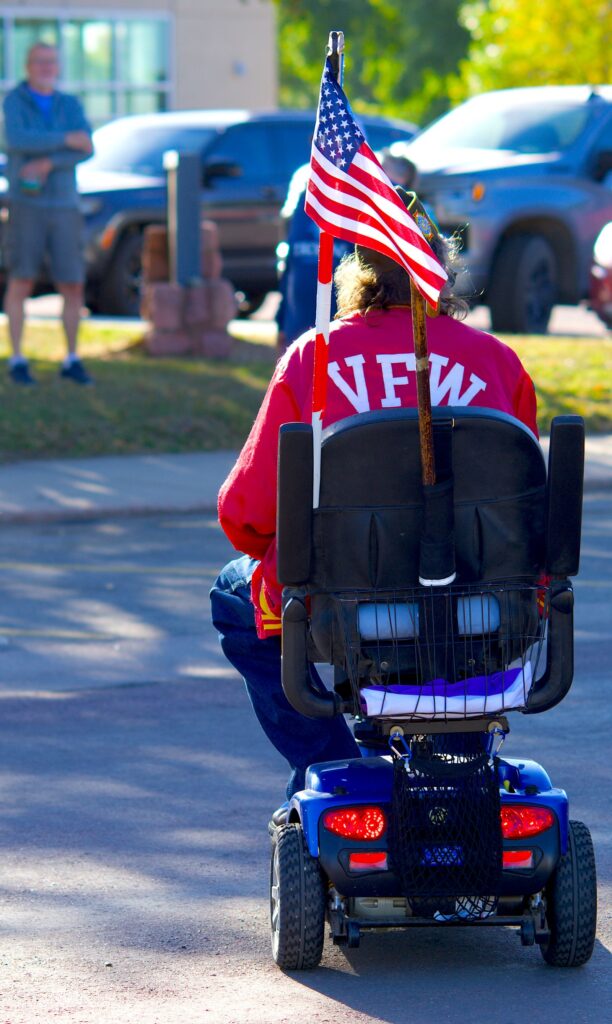
Many veterans with a 100% rating rely on mobility equipment and help at home. SB 296 is aimed at keeping them in the houses they have adapted.
Unmarried surviving spouses
An unmarried surviving spouse can receive the same exemption the veteran would have received, including the 100% tier if household income is at or below the limit, when either of these is true:
- The veteran qualified for the exemption during their lifetime (or would have under the law in effect on January 1, 2024, for veterans who died before that date), or
- The veteran died from a service-connected injury or disease, as determined by the VA.
In both cases the veteran must have been a California resident on January 1 of the year they died, and the home must have been the veteran’s principal residence at the time of death.
The Rule Home Care Families Should Know About: Hospital and Care-Facility Stays
One provision in SB 296 speaks directly to families who care for a disabled veteran. If the veteran, or an eligible surviving spouse, is confined to a hospital or other care facility, the house still counts as their principal residence as long as it would be their home but for that stay and it is not rented or leased to a third party. The law says plainly that a family member who lives in the home is not a third party.
That matters in real life. A veteran who spends six weeks in rehab after a fall, or months in a skilled nursing facility while the family arranges care at home, does not lose the exemption simply because they are temporarily somewhere else. A daughter who moves in to keep the house running does not count as a tenant. If the plan is to bring Dad home with in-home support, the tax break stays with the house while that plan comes together.
What It Could Mean on an Orange County Tax Bill
California’s general property tax rate is 1% of assessed value, set by Proposition 13. Voter-approved bonds and local measures add to that, and fixed charges or special assessments on the bill may not change at all. The examples below look only at the general 1% levy to show the scale of the change. They are illustrations, not tax advice.
| Assessed Value | Household Income | Value Exempted Under SB 296 | Approx. Reduction in the 1% General Levy |
|---|---|---|---|
| $600,000 | Above $83,474 | $300,000 (50%) | About $3,000 a year |
| $600,000 | $83,474 or less | $600,000 (100%) | About $6,000 a year |
| $1,200,000 | Above $83,474 | $500,000 (50% of the first $1M) | About $5,000 a year |
| $1,200,000 | $83,474 or less | $1,000,000 (100% of the first $1M) | About $10,000 a year |
Because SB 296 replaces the existing veterans’ exemption rather than adding to it, a household already receiving the Disabled Veterans’ Exemption will see the difference between the old and new amounts, not the full figure above. Your actual savings depend on your assessed value, the local rates in your tax rate area, and the adjusted dollar limits for the year.

For a household paying for in-home help, several thousand dollars a year in property tax savings can cover a meaningful number of care hours.
Timeline: When the New Exemption Starts Counting
| Date | What Happens |
|---|---|
| September 28, 2026 | Governor signs SB 296; as a tax levy it takes effect immediately |
| January 1, 2027 | First lien date the new exemption applies to. Lien dates set the tax year that begins July 1, so this one governs the 2027–28 bill |
| February 15 | The Orange County Assessor’s current deadline for Disabled Veterans’ Exemption applications (or 30 days after a supplemental assessment notice, whichever comes first) |
| June 1, 2027 | First annual State Board of Equalization report to the Legislature on how many homeowners received the exemption and how much value was exempted |
| January 1, 2031 | Last lien date covered |
| January 1, 2032 | Section 205.5.1 is repealed unless the Legislature extends it |
As of October 8, 2026, the Orange County Assessor’s disabled veterans page still describes only the existing exemption and has not yet posted SB 296 claim instructions. The new law requires claimants to give the county assessor documentation, including a letter from the VA or the veteran’s military branch showing the disability rating. It does not say whether people already receiving the existing exemption will be moved over automatically, so it is worth calling the Assessor’s office at (714) 834-5945 to ask.
Why Lawmakers Passed It
The bill states its goal in one line: to reduce homelessness by giving 100 percent disabled veteran homeowners a tax exemption. The reasoning is straightforward. A veteran living on a fixed disability check who owns a home outright can still be pushed out by rising property tax bills, especially in a county where values have climbed as much as Orange County’s have. The State Board of Equalization will report yearly through 2031 on how many people use it, which will shape whether it gets extended. The state will not reimburse counties for the lost property tax revenue.
How This Connects to Care at Home
For most families we work with, a disabled veteran staying at home is not one decision. It is a stack of them: paying for help, adapting the house, and keeping the household budget intact. SB 296 handles the property tax part. Other pieces may already be available:
- VA programs that pay for in-home care for eligible veterans, which we explained in The Dole Act Raised VA’s Home Care Spending Cap to 100%: What It Means for Orange County Veterans.
- The VA pension with Aid and Attendance for wartime veterans and survivors who need help with daily activities, covered in our VA Aid & Attendance 2026 guide.
- Forgivable grants for accessibility repairs, in OC Senior Home Repair Grants 2026.
- An honest look at what in-home help costs locally, in The Real Cost of Home Care in Orange County (2026).
Your SB 296 Family Checklist
Click each step as you finish it.
- Confirm the veteran’s VA rating is 100% (or 100% for individual unemployability), or that they are blind in both eyes or have lost the use of two or more limbs from service
- Request a current VA benefit letter that shows the disability rating
- Check whose names are on the deed and confirm the home is the principal residence
- Look up the home’s assessed value on the most recent property tax bill
- Estimate total household income to see whether you may fall at or under $83,474
- Note whether you already receive the Disabled Veterans’ Exemption or the $7,000 Homeowners’ Exemption
- Call the OC Assessor at (714) 834-5945 and ask how SB 296 claims will be handled for the 2027 lien date
- Put February 15, 2027 on the calendar as the working filing deadline unless the Assessor says otherwise
- If the veteran is in a hospital or care facility, make sure the home is not rented to anyone outside the family
- Surviving spouse: gather the death certificate and proof of the veteran’s rating or service-connected cause of death
Test Your Knowledge
Frequently Asked Questions
No. The new exemption applies to lien dates from January 1, 2027 onward. The January 1, 2027 lien date governs the 2027–28 tax year, so the first bill that can reflect SB 296 is the 2027–28 secured bill. The existing exemption continues to apply to the current year.
Not on a 70% rating alone. SB 296 requires a service-connected total disability (a 100% rating, or 100% compensation because the veteran cannot work), blindness in both eyes, or loss of use of two or more limbs. If his condition has worsened, it may be worth asking a veterans service officer about a rating review.
The law does not say whether current recipients will be converted automatically. It does require claimants to give the assessor documentation, including a VA or military letter showing the disability rating. Call the Orange County Assessor at (714) 834-5945 and ask how they will handle existing recipients for the January 1, 2027 lien date.
No. It is based on the home’s full value for property tax purposes, which for most long-time owners is the Proposition 13 assessed value shown on the tax bill. That is often well below market value in Orange County. The statute also adjusts the $1,000,000 figure over time.
No. SB 296 extends the exemption to an unmarried surviving spouse, and only when the veteran either qualified during their lifetime or died of a service-connected cause, was a California resident on January 1 of the year of death, and lived in the home when they died.
No. It covers lien dates through January 1, 2031 and is repealed on January 1, 2032 unless lawmakers extend it. The State Board of Equalization must report on its use every year from June 1, 2027 through June 1, 2031, and those reports will inform any extension.
Help That Lets a Veteran Stay in the Home They Earned
At Home VA Staffing provides non-medical in-home care across Orange County, from a few hours a week to daily support with bathing, meals, mobility and companionship. If keeping a disabled veteran at home is the goal, we can talk through what help would look like.
Talk to Our Team: (213) 326-7452Proudly Serving Orange County Communities
This article is for general informational purposes and is not legal or tax advice. It summarizes Senate Bill 296 (Chapter 727, Statutes of 2026), signed September 28, 2026, which adds Section 205.5.1 to the California Revenue and Taxation Code for lien dates from January 1, 2027 through January 1, 2031. Dollar figures in the statute are adjusted annually, and the savings examples above are rough illustrations based only on the 1% general levy. Claim procedures had not been posted by the Orange County Assessor as of October 8, 2026; confirm eligibility, deadlines and required documents with the Assessor’s office. At Home VA Staffing is a non-medical home care agency and is not affiliated with the U.S. Department of Veterans Affairs, the State of California, or the County of Orange.